Naan
Soft Indian flatbread with garlic and coriander, baked in a dry pan that you then hold upside down over the flame.
A cookbook is coming. I am working on a cookbook with the dishes from my workshops. Leave your email and you will be the first to know when it is ready.
No newsletter, no advertising. One email, when the cookbook is ready. Your address is stored encrypted and shared with nobody.
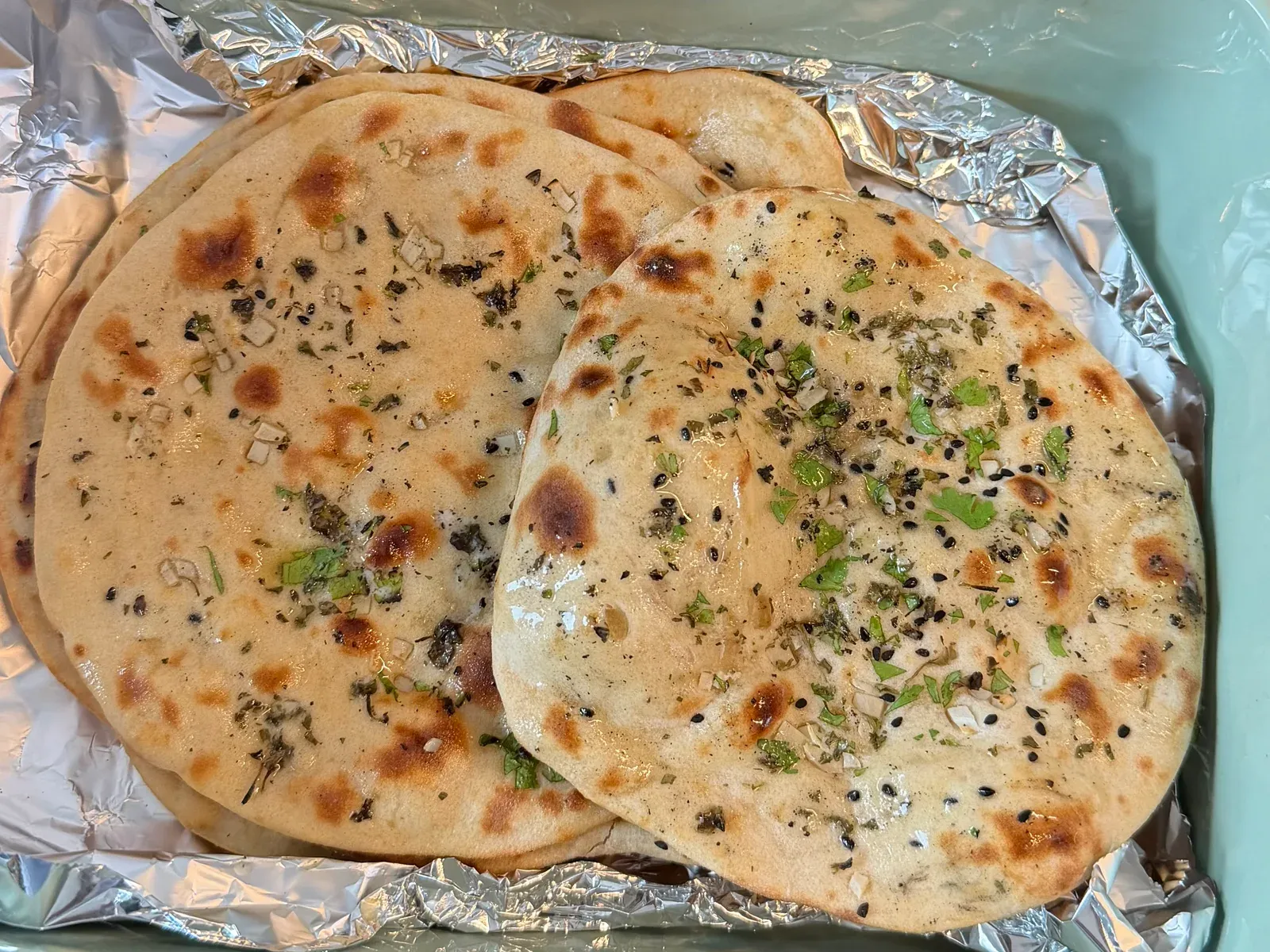
Naan is normally baked in a tandoor, a clay oven where the dough sticks to the hot wall. At home you can imitate that with an ordinary pan: you stick the naan to the base with a film of water, and once the underside is done you turn the pan over the flame.
Do not use a non-stick pan, because the naan is meant to stick. Stainless steel or cast iron works best, completely dry and without oil.
There is no yeast in this dough, it rises on baking powder and bicarbonate of soda. It does need to rest for at least 2 hours and preferably 6. The longer it rests, the softer the naan.
If you cook on induction or electric you cannot invert the pan over a flame. Bake the naan on both sides in the pan instead, or put it briefly under the grill afterwards.
Tip. Do not turn the dough over while rolling it out. The garlic and coriander stay on the top side, because that side does not touch the pan.
Method
- 1
In a large bowl combine 80 g water, 60 g milk, 120 g yoghurt, 1 tbsp oil and 16 g icing sugar. Whisk until smooth.
- 2
Add 250 g plain flour, 120 g wholemeal flour, 2 tsp baking powder, ¼ tsp bicarbonate of soda and a pinch of salt. Mix with a spoon or your hand until all the liquid is absorbed and you have a rough, shaggy dough.
- 3
Bring the dough together with your hands until no dry flour remains. Turn it onto a work surface and knead by stretching, folding and pressing. Keep going for 10 to 15 minutes, until the dough is smooth, soft and only slightly tacky.
- 4
Shape the dough into a ball and lightly oil its surface. Put it back in the bowl and cover with a damp cloth so it does not dry out.
- 5
Let the dough rest at least 2 hours, preferably 6. That makes for a softer, more flavourful naan.
- 6
Divide the dough into equal pieces, each slightly larger than a golf ball. Roll them into smooth balls, put them on a tray, coat them lightly with oil, cover and rest another 10 to 15 minutes. This second rest stops the dough shrinking back while you roll it.
- 7
Put a stainless steel or cast iron pan over high heat. The pan must be bone dry with no oil: the naan is supposed to stick to it. So no non-stick pan.
- 8
Dust one ball lightly with flour and roll it into a thick disc of 10 to 12 cm. Scatter the chopped garlic and coriander evenly over the top.
- 9
Carry on rolling into a naan shape about 5 mm thick. Do not flip the dough while doing so: the garlic and coriander stay on top. If it sticks, dust with a little more flour.
- 10
Lift the naan carefully with the topped side against your palm. With your free hand, spread a thin film of water over the bare underside. That water works as glue.
- 11
Put the naan straight into the hot pan, wet side down. Press lightly with your fingers or the back of a fork so it makes contact everywhere.
- 12
Lower the heat to medium and cook until bubbles form and the underside sets, about 1 to 2 minutes. Once large bubbles appear, invert the pan over the flame so the top gets direct heat. Move the pan around so it does not burn. Cook until golden brown spots appear and the edges are lightly charred.
- 13
Loosen the naan with a metal spatula and transfer it to a plate. Brush generously with melted butter and eat it straight away.
Rather learn together?
Learn this and other dishes hands-on during an Indian cooking workshop or cooking lesson in Heerenveen.
Request a workshop or lesson